Davies Symphony Hall, San Francisco Symphony, Sunday, May 10, 2026 — It was a concert with musical surprises. The program included three composers, each totally different than the others, Henri Dutilleux, Jacques Ibert, Piotr Ilyich Tchaikovsky. It was an exciting event. The conductor, Dima Slobodeniouk, was great to watch. He had a marvelous way to be at one with the musicians.
I confess I have heard or read the name Dutilleux (1916-2013), but I do not think I had ever heard his music. It was music with a fascinating way to create the Metaboles (1964). Maestro Slobodeniouk opened the concert by describing how each of the composers wrote their music. The Metaboles was built with five sections: Incantatoire: Largamente; Lineaire: Lento moderato; Obsessionnel: Scherzando; Torpide: Andantino; Flamboyant. Each section is able to match the music to the characteristic of their names which also suggest a way into an instrumental section. These sections evolve as though each section is separate but over time the sections meld into an orchestra. It is more visual than one might have seen that happen as the sections become whole. The third section, Obsesstionnel, takes the music into the brass instruments. Then, the Torpide section lives in percussion and clarinets. While the description might make the listener to Metaboles think it is entirely a mathematical plan, but once it began it was very musical music and opened a path to Dutilleux’s innovation.
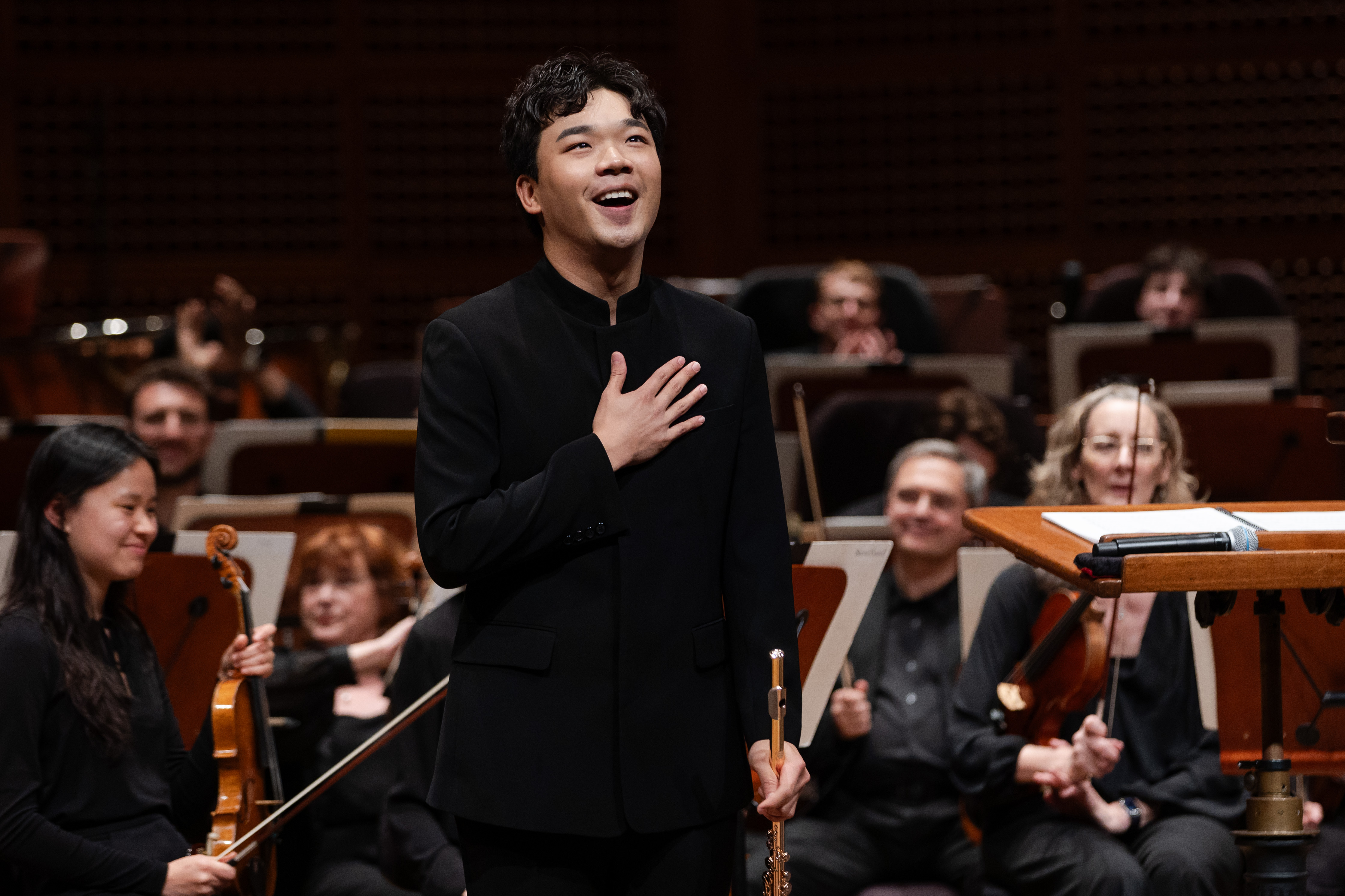 Yubeen Kim, Principal Flute of SF Symphony
Ibert (1890-1962) had a style of his own; it was to avoid aesthetic rules or some group’s rule. He went his own way wining the Prix de Rome and composing for theater, films, opera, ballet, symphonies and chamber works. He composed for sixty films including Orson Welles’ Macbeth. His Flute Concerto (1934) is written for a dazzling virtuoso musician and that is exactly what the audience got to see and hear. Yubeen Kim has only been Principal Flute for the SFS since January 2024. He touches the flute fast and faster and also serves his lyrical flute to the audience which sits there, mouths open. As Maestro Slobodeniouk mentioned when describing the Flute Concerto, Yubeen Kim must be the best anywhere. Yes, that must be true. The flute floated, danced, maybe once walked on a tight rope, inserted bits of jazz and enjoyed the syncopation. It is an amazing Concerto and we, the audience, were thrilled every moment.
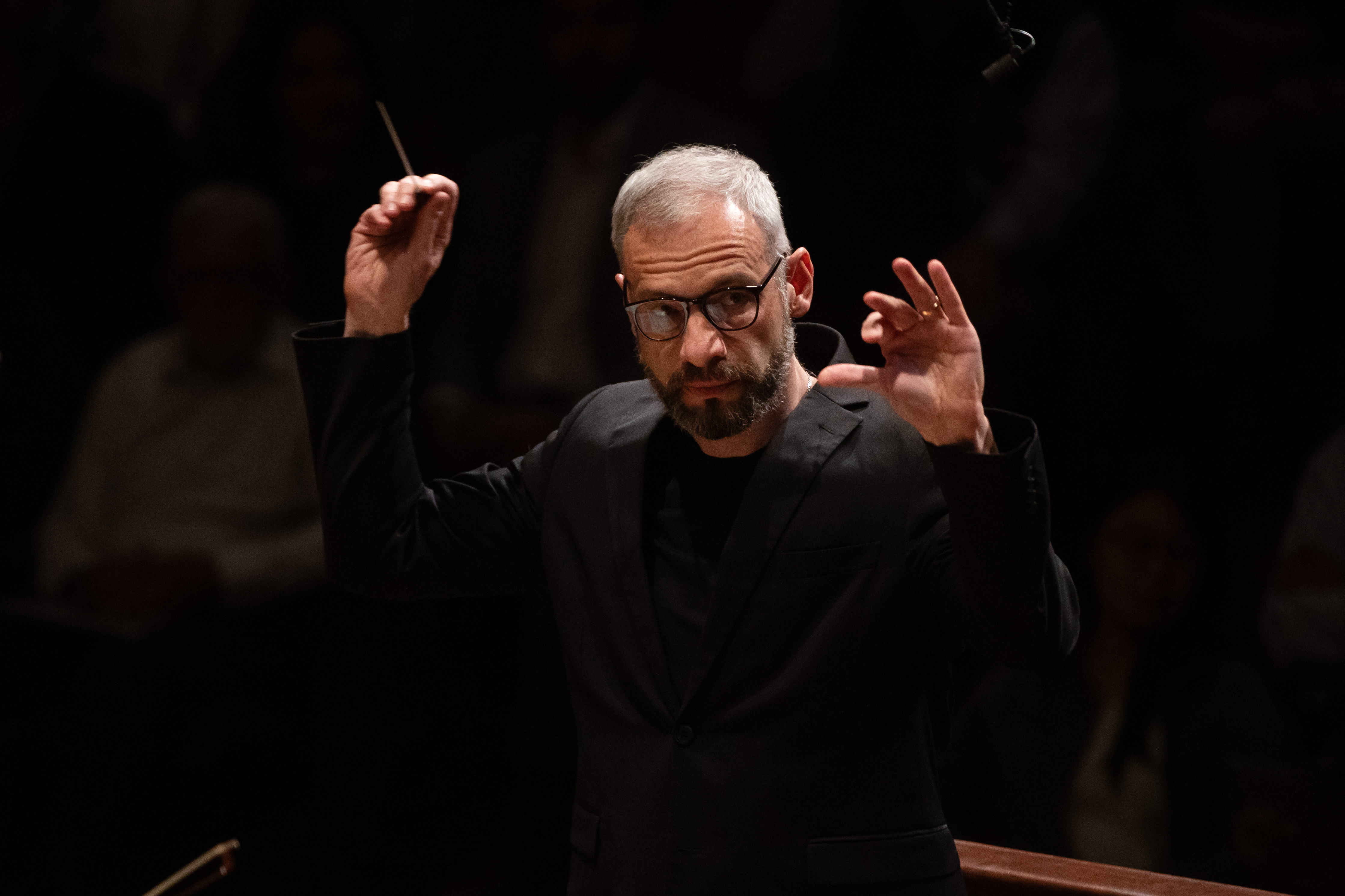 Dima Slobodeniouk, Conductor
Tchaikovsky’s Symphony No. 4 in F minor, Opus 36 (1878) is great in art and by size. According to Tchaikovsky’s letter to his patron, he gave the idea of Fate deep thoughts and fears. He wrote that Fate “prevents our pursuit of happiness from reaching its goal.” The Symphony No. 4 found a way for his composition to examine and involve both the Western styles and the Eastern, mostly Russian, in his work. By using the presence of the different traditions, or modern rather than traditions, he let their musical angles put the energy between them which brought out something new. The Symphony opens with loud, startling, attacks. The second movement is a slow Andantino in modo di canzona; it is a sad song. The instruments are not the first to choose for a triumph or happy day; they are oboe, cellos, and then the bassoon. Tchaikovsky calls out the instruments for constant variation. The strings pluck as though they are hurried because they are left out of the country music for woodwinds. This is not the way the standard symphony works. He relishes the opposites. The Finale: Allegro con fuoco closes the symphony, but it does not answer the question. Is he soaring above our world or does he finish with the punishing attack of loud amazement? He returns briefly to Russian folksong but does not stay there. He hears what makes the end: not knowing what he wishes to know.
THE CONDUCTOR: Dima Slobodeniouk was excellent. He offered explanations of the nature of the three very different works. His descriptions were clear and helpful. He was personable but did not simplify what he was saying. I thought it was a great help for understanding what to notice and how the conductor would lead the musicians. He was 100% engaged with each composer’s design and originality; so, he led the orchestra into each composer’s art. His movements were graceful even when signaling surprising, crashing music. I felt that I could see the way he was directing and where I would look from the percussion to the horns. He seemed to have a private conversation with each musician. It was an exciting experience.
Photos by Brittany Hosea-Small with compliments of San Francisco Symphony