We are home again and ready for a San Francisco Symphony concert. It felt very good. The program was subito con forza (2020), by Unsuk Chin; Symphony No. 4 in D minor, Opus 120 (1841/51), by Robert Schumann; Piano Concerto No.1, in D minor, Opus 15 (1858) by Johannes Brahms. Garrick Ohlsson was the magnificent pianist for Brahms’ Concerto.
The Conductor was David Afkham. He has been chief conductor and artistic director of the Spanish National Orchestra. In recognition of leadership he received awarded the Order of Alfonso X the Wise for culture, education, and science. He has led great orchestra in Europe and the US: Concertgebouw Orchestra, London Symphony, Vienna Symphony, Chicago Symphony, Philadelphia Orchestra, St. Louis Symphony and many more.
Maestro David Afkham mentioned that Unsuk Chin’s six minute subito con forza had audio references that echoed several Beethoven’s sounds. The piece was definitely not Beethoven’s music, but the sudden use of a whip, xylophone, cymbals, tam-tam, and more percussions created an innovative music.
Schumann’s Symphony No. 4 in D minor, Opus 120 shares similar struggles with Brahms’ Piano Concerto No. 1 in D minor. When Schumann was to premiere this symphony, he thought Mendelssohn would conduct. Sadly, Mendelssohn could not be there and the orchestra had not had enough rehearsal time. His publisher would not publish it even though it received some good reviews. Schumann put this symphony that premiered in 1841, he set it aside for a decade. Schumann reworked it and it re-premiered in 1853. Brahms published the 1841. The 1841 version is still played, but we heard the 1853 version
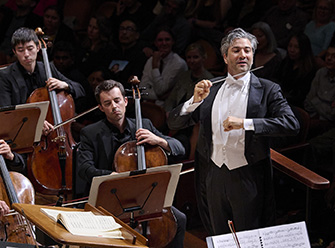
The San Francisco Symphony with David Afkham, conductor, and Garrick Ohlsson, piano, in a performance of Unsuk Chin’s “subito con forza,” Robert Schumann’s “Symphony No. 4,” and Johannes Brahms’s “Piano Concerto No. 1.” At Davies Symphony Hall on Friday night, September 19, 2026. Photo by Stefan Cohen
Schumann found a theme in a solo piano work by Clara Schumann in 1833. The first movement feels like we are outside. The woodwinds turn the Symphony into a happy F major. The second movement is Romanze: Fairly slow. It seems to sing to us while wandering, looking for open space. The third movement is Scherzo: Lebhaft, meaning Lively. Schumann makes a gorgeous rhapsody with a violin theme played by the whole string section. The rhythm from the first movement is now a fugue with a sunny temperament as the groups of instruments brighten their place and sound. The Symphony could have found a worldly paradise. There are melodies that are vibrant; his “Clara” thoughts produce excitement. Though brief, it is always the new innovative Schumann.
Brahms and Robert and Clara Schumann were very close friends. Brahms, came to them when he was young. Schumann wrote about music in a newspaper, now exclaiming that Brahms is the next Beethoven. Brahms was 14 years younger than Clara. Robert and Clara had 7 children. Brahms knew he could never fall in love or change their lives, but love was always there. Robert died in 1856. Brahms helped her with the children. Clara and Brahms exchanged many letters about their music.
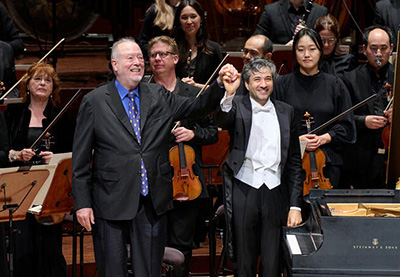
The San Francisco Symphony with David Afkham, conductor, and Garrick Ohlsson, piano, in a performance of Unsuk Chin’s “subito con forza,” Robert Schumann’s “Symphony No. 4,” and Johannes Brahms’s “Piano Concerto No. 1.” At Davies Symphony Hall on Friday night, September 19, 2026. Photo by Stefan Cohen
Brahms struggled with his composition. It was to be a concerto, then two pianos as a sonata, and then a symphony. He took three years to get it going, but the opening movement was something new: breaking the music’s continuity and dissonance that might disturb even an audience in the 21st century. The Adagio, second movement, has an elegy for Robert and a “tender portrait” describing Clara. He had said she was “going to the concert hall like a priestess to the altar.” Although he existed with angst for all the time he worked on his First Piano Concerto, he did not get what he hoped for. He was the soloist. They had rehearsals that went well. However, there was a distant attitude for him and his music in Hanover. His premiere in Leipzig Gewandhaus was a bomb. No one liked his Piano Concerto No. 1. Brahms wrote the “failure has made no impression whatsoever on me….After all, I’m only experimenting and feeling my way as yet. But the hissing was too much of a good thing, wasn’t it?” The Piano No. 1 was a flop in Leipzig, but of course Brahms kept going. The SFS played a powerful and beautiful concerto. With the soloist Garrick Ohlsson nothing went wrong. It was what Brahms heard in his head and his heart knowing that this great pianist had it all.
Thanks to the SF Symphony for these photos.