Davies Symphony Hall, San Francisco, June 14, 2026 – This was an unusual program. Three composers each brought the music of their distant origins. The conductor was Tianyi Lu. Performing this concert was her debut with the SF Symphony. She was brilliant. In addition to her outstanding relationship with the musicians, she used her arms with strength as well as movement that is graceful. She is a very special conductor. Her recent appearances include the BBC Proms and the BBC Symphony, New York Philharmonic, Montreal Symphony, London Philharmonic and many more. I hope she will save time for us.
The SF Symphony has opened concerts with a relatively short piece of new music by new composers. Zhian, by Iman Habibi, truly grabbed my heart. I hope to hear more of his work. He was born in Tehran. He and his family left Iran and became Canadians. This piece was inspired by Mahsa Amini, a woman who was arrested by the Guidance Patrol, the morals police. She was killed and there were many protests. Habibi used the words Zhian, meaning life in Kurdish, Mahsa Amini was a Kurdish Iranian, and “indignant” or “formidable” in Persian. He said,”Those are the best words I can use to describe the bravery of the Iranian people who came to the streets to protest and to advocate for the basic human rights.” Zhian reminded me of Shostakovich. This is not that I think Habibi “borrowed” from Shostakovich, but both composers were making art while people were arrested, imprisoned, and many killed. The sounds of the music are interesting and sometimes frightening. There are times when loud music could suggest destruction, but there are quiet spaces which are even more frightening. Here in Northern California we do not see all the horrors. Not now, not yet. Habibi said, “…this piece resonates with renewed urgency in the wake of the 2026 protests and the subsequent violence…I stand with my compatriots in their quest for a free, just, and green future.”
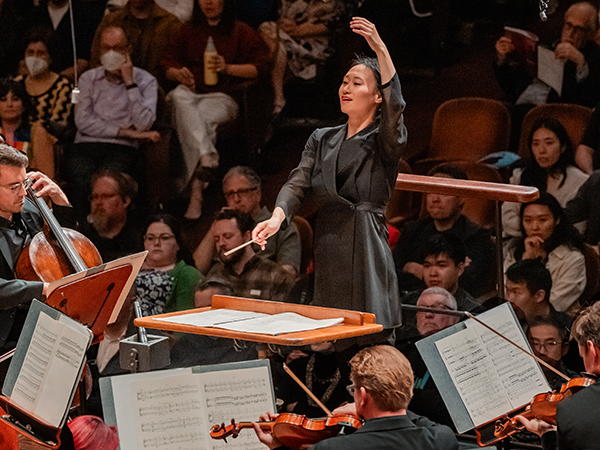
Tianyi Lu conducting Korngold’s Violin Concerto in D major, Opus 35, photo by Brandon Patoc
Erich Wolfgang Korngold was a child prodigy. He began to compose when eight years old. He composed his ballet, the Snowman, it had its premiere at the Vienna Opera. Mahler was impressed and suggested a mentor for him. He created large orchestra works and chamber music. It was all very good, classical music. He wrote an opera, The Dead City, and theaters struggled to be able to perform it. However, films were going to change his life, or film saved his life. Max Reinhardt convinced him to arrange Mendelssohn’s A Midsummer Night’s Dream with a new version of the play with Reinhardt directing. Korngold decided to do it and commute between Vienna and California. As luck had it, he was in California when Nazis took over Austria. He was working on the music for The Adventures of Robin Hood, played by Errol Flynn. He was able to bring his family in California. It took time, the whole of World War II, for Korngold to be able to resume composing classical music. A fine violinist who founded the Israel Philharmonic, Bronislaw Huberman, urged Korngold to make a concerto for him. In the summer of 1945, the concerto was completed, but Huberman passed away. Fortunately, Jascha Heifetz gave the concerto’s premiere in 1947 with the St. Louis Symphony, and Heifetz made its first recording. Critics took the chance to make Korngold typecast as “only”a film composer. He might have been feeling pushed aside. The Concerto is now recognized and played. So is his opera, The Dead City (Die tote Stadt) which I saw years ago at the SF Opera. The Violin Concerto in D major, Opus 35, played by Maria Duenas, was lovely, sometimes delicate, other times full of energy. It had the sound of America coming through in the nick of time. I think Thomas May, the writer of the program notes has an insight to what happened to American emotions soon after the war: “Even if straightforward expression of emotions was considered verboten in avant-garde circles in the post-war years, movies provided an outlet.”
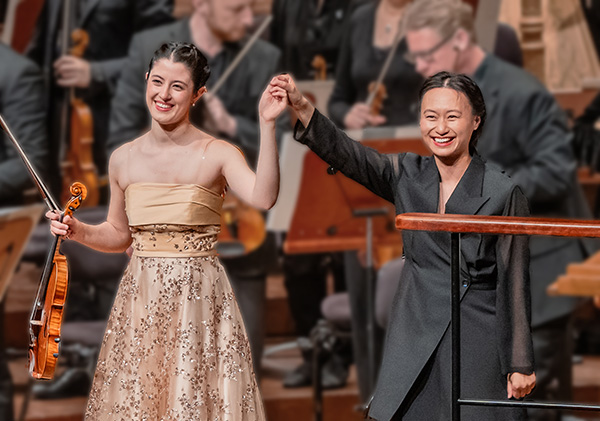
Tianyi Lu conducting Korngold’s Violin Concerto in D Major,Opus 35, Solo Violinist Maria Duenas, photo by Brandon Patoc
Scheherazade, Opus 35, by Nicolai Rimsky-Korsakov, is music that creates a whole world. I am familiar with the music but wonder if I heard it live? I must have; it is so wonderful. It is full of adventure, magic, treading through waters, climbing, dancing, thrilling by the princess who knows how to make anger or depression blossom into a golden time for imagination. There were two ways for these stories to turn into performances. One is Diaghilev’s ballet, guess what — there is no Storytelling Princess. The other is Rimsky-Korsakov’s musical great experiences. I did not pay a lot of attention to the various titles of the movements, but this music is the equivalent of a book you never want to finish. There are marvelous moments for instruments to play solo; Alexander Barantschik, the Concertmaster, played the music like it was silken cloud. There were violas, oboe, and English horn making surprising music. That group opens new colors and new thoughts because Scheherazade is able to keep imagining without a stop. She is a brainy princess; you see, a princess can be ready for whatever vision she will see. The Sultan who married this amazing princess whom he thinks he will kill, except, he needs to know what happens in the story. She has to save her life. She tells a tale, but she stops at sunrise and starts again because he has to know what happens. She comes up with the exciting story that will allow her to have one more night. As you know, she managed to find One Thousand and One fabulous stories on the sea on the land in her imagination which took the Sultan on the ocean on the raft of his princess’s mind of dreams that are not exactly real, but she makes the dreams real enough.
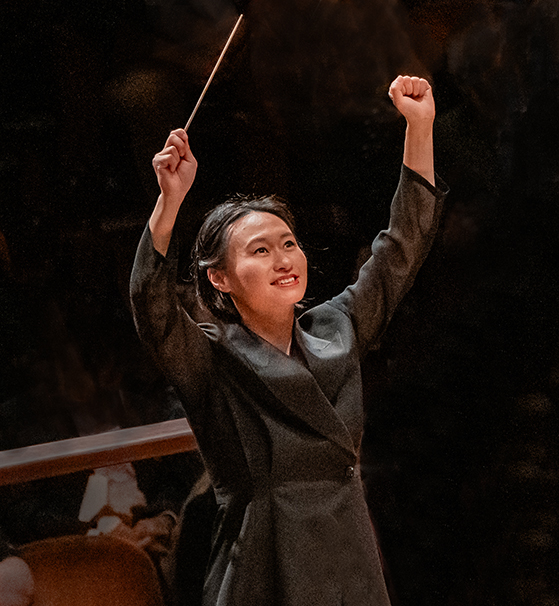
Scheherazade with Tianyi Lu conducting the San Francisco Symphony, photo by Brandon Patoc
Photos by courtesy from SF Symphony.