Monthly Archives: November 2025

Extraordinary Music Led by Extraordinary Alexi Kenney

November 21, 2015 – Davies Symphony Hall, San Francisco – San Francisco Symphony members performed beautifully in an extraordinary, musical adventure. Alexi Kenney played violin and served as leader for the group. This was a Baroque presentation: all the musicians stood while playing; that is all except the harpsichordist. The music was equally very old, ca. 1664 and early 18th century; and very new. The Baroque sound is different than Classical and Romantic. We have lost touch from the 18thc. Early 18thc. humans walking around with music in their heads had delightful music to hear. Mr. Kenney played brilliantly. His great energy and devotion to the music spread to the other musicians as well as the audience.

Olli Mustonen, composer ( born 1967)

The opening piece was the only one composed in 2000. Nonetto II for Strings, by Finnish composer Olli Mustonen, has traces of Baroque music while it is still modern. It is a wonderful, appealing piece which can draw the listener’s warm attention. It was fifteen minutes long, and I would have happily let it go on. I referred to the program to be sure it has no Baroque ancestry. It is all modern with the Baroque musicians sending an occasional telegram for their part in Mustonen’s innovations.

Barbara Strozzi, composer, singer (1619 – 1677)

A very brief piece, “Che si puo fare,” Opus 8, no. 6., by Barbara Strozzi, about 5 minutes, was arranged by Alexi Kenney. Barbara Strozzi was a popular composer and singer. Anything about her that is known for sure is unusual in mid-17thc. An Italian woman in Venice, publishing her own compositions, and published eight volumes of vocal music. These songs were secular, not for the church. According to the program note, “she may have been the most published composer within her genre in Venice.” She died young, 58; it took 300 years before she was rediscovered. Its brevity made it difficult to get into it, but it has the same Baroque, tangy sound that seems so new to jaded twenty-first century listeners. A paraphrase of Ms Strozzi song:

“What can I do? The stars have no pity. If the gods won’t grant me peace, what can I do?/ What can I say? The heavens keep sending me disaster…What can I say?”  If Ms Strozzi had read Sappho, they could sing a duet.
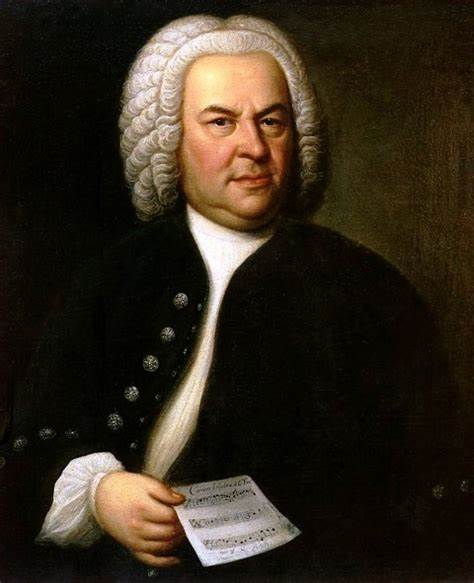
Johann Sebastian Bach, composer (1685 -1750)

Bach wanted to move in order to get a better job. He wrote the Brandenburg concertos to tempt Margrave Christian Ludwig of Brandenburg-Schwedt to bring Bach to his employment. It did not work. Instead, Bach moved to Leipzig in 1723. Bach’s concertos disappeared until 1849. The Brandenburg Concerto No. 5 in D major, BWV 1050 was a new kind of concerto. This one has violin, flute, and harpsichord soloists. It was a careful mix of the old style of concerto grosso and the new concerto with more solos. This was a great, tuneful, rhythmic Bach. The musicians were all excellent. I wished the harpsichord could be heard better while playing with the strings. Not the harpsichordist fault; when he played solo one could hear very well. Possibly, the instrument would be better heard in a smaller venue. When I was a kid, friends wanted to play pop music in their piano classes, I wanted more Bach. Still do.

Antonio Vivaldi, composer, violinist (1678 – 1741)

The Four Seasons, Opus 8, nos. 1-4, by Antonio Vivaldi, has become favorite “classical” music. Vivaldi worked at the Ospedale della Pieta in addition to being the “master of music in Italy.” The Ospedale della Pieta was a home and music school for female orphans and illegitimate daughters of wealthy nobles. It interests me that some of the music was written by Vivaldi years before he wrote The Four Seasons. Then, he composed new additions some of which were more complex. One of his major, new approaches was to write poetry and music all together in pictures of the seasons. Spring paints a picture of buds opening, singing birds returning, sudden storms come and then bring quiet. In the middle of the 20thc., The Four Seasons began to be popular again. Perhaps now, its loveliness can come back in our not so lovely era.
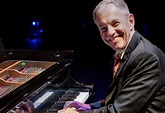
 

Beethoven Program: Barantschik, Wyrick, Nel

November 16 – Gunn Theater, Palace of the Legion of Honor

The trio of Brarantschik, violin; Wyrick, cello; Nel, piano presented a breathtaking concert of Beethoven trios. The musicians selected three magnificent trios. These artists master the intertwining collaborations of each instrument. It leaves the audience to wonder how they do it and how lucky they, the audience, are to be there.

Alexander Barantschik, violin, San Francisco Symphony’s Concertmaster. Previously he was concertmaster of the Bamberg Symphony Orchestra, London Symphony Orchestra, and Netherlands Radio Philharmonic. He performs as soloist and chamber musician. As concertmaster of the London Symphony, he toured Europe, Japan, and the US.

The program began with Beethoven’s Piano Trio in E-flat major, Opus 1, no.1,1795. The title including “Opus 1, no.1” shows that he felt he was at the true beginning of his career. He had created other compositions and presented them in private performances, but this Trio was to be published and performed with different expectations. It is a mature piece. He plays with his ideas and technical construction of the interaction of the the three instruments. The Allegro sounded light and active as he allows dashing music while he adds brief ornaments. In the Adagio, we hear singing in the piano’s solo. Violin and cello carefully join in a quieter, even solemn mood, but that does not last. The Scherzo: Allegro assai has suggestions. The music plays hide and seek as it changes, stops, returns. The Finale: Presto lets us hear the intensity of Beethoven’s desires as the piano has a quizzical position that receives the answers from violin and cello. He takes note of the first movement, and all three combine in a Beethoven upright and quick end.

Anton Nel, piano, is a recitalist, concerto soloist, chamber musician, and teacher. He has appeared internationally at Wigmore Hall, the Concertgebouw, Suntory Hall, and major venues in China, Korea, and South Africa. He has the Lozano Long Endowed Chair at the University of Texas, Austin, and teaches at the Aspen and Ravinia Festivals.

Variations in G major on “Ich bin der Schneider Kakadu,” Opus 121a, 1794-1804=3? (rev. 1816). This piece has many variations, moods, and possibly a humorous point of view under the serious technique. The inspiration came to Beethoven through the song “Ich bin der Schneider Kakadu.” That means “I am the Tailor Kakadu.” The composer was Wenzil Muller, a composer of light songs for his singspiel. It could be an ancestor of musical comedy. The dates above show that there are many questions about when Beethoven wrote this work of ten variations. It could have popped into his mind very soon after he first heard it or maybe he remembered it years later, but it is the variations that make this piece. With thanks to James M. Keller, program annotator, “contrapuntal possibilities (as in the canons of Variations V and VII) deconstructing the theme (Variation VI), subjecting it to syncopation(Variation X).” There are more. Beethoven came upon more ideas  which were put in the Allegretto coda as he tried to sell it in 1816.

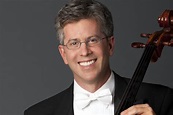
Peter Wyrick, cello, was a member of the San Francisco Symphony 1986-’89. He returned to SFS as Associate Principal Cello, 1999-2013, retiring in 2024. Previously, he was Principal cello of the Mostly Mozart Orchestra and associate Principal cello of the New York City Opera. He been soloist with SFS in C.P.E. Bach’s Cello Concerto in A, Bernstein’s Meditation No.1 from Mass, music of Tan Dun’s Crouching Tiger, Hidden Dragon.

Piano Trio in B-flat major, Opus 97, Archduke marks a painful change in Beethoven’s work. This piece, composed in 1811, was the last time he would perform. His hearing had gone too far. The piece was not performed until 1814. It was too late. The Archduke in the title was Archduke Rudolf who was younger brother of Emperor Francis I. Beethoven taught piano to the Archduke; they were as close as they could be, given Beethoven’s non-royal background.  This Piano Trio has presence just as a royal Trio should be. The cello leads the melodic first movement, Allegro moderato. The strings have a wonderful, pizzicato Scherzo time, delightful, almost strange, but completely together. The Andante cantabile, slow and touching, adds four variations. This movement has warmth that reaches out to keep the spirit around us. The music takes us back to Allegro moderato, though it calls all to a sharp, fast, rondo finale.

Benjamin Pesetsky quoted Louis Spohr, violinist and composer, who remembered how Beethoven “pounded on the keys until the strings jangled, and in piano he played so softly that whole groups of tones were omitted…I felt moved with the deepest sorrow at so hard a fate.”


3 Composers PLUS Great Conductor & Pianist

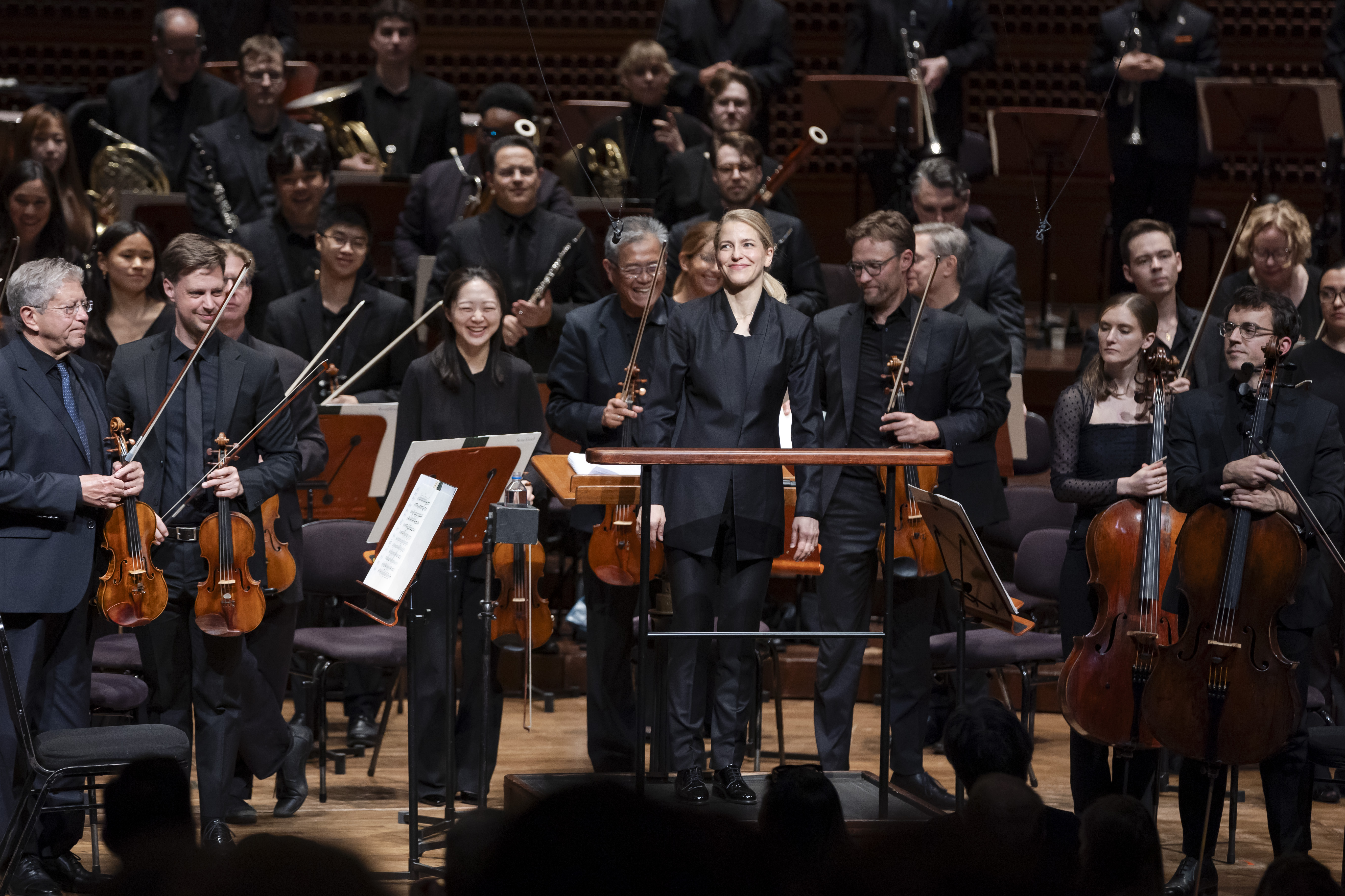
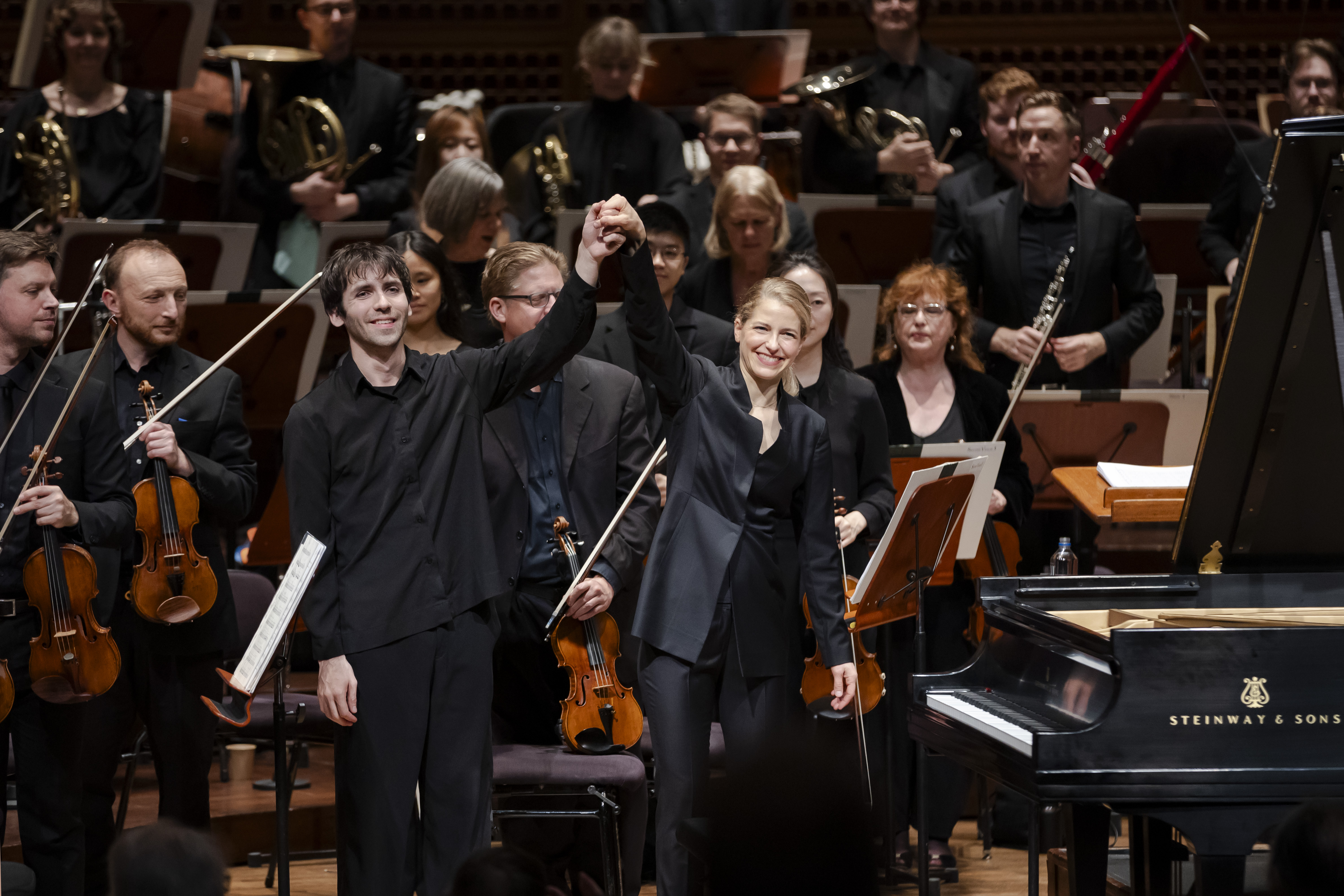
San Francisco’s Davies Symphony Hall welcomed stellar artists and amazing music, 11/6 -11/8. The SF Symphony made a performance to remember with the outstanding pianist, Alexandre Kantorow, and the conductor, Karina Canellakis. Both truly blew us away. In the last season, her audience was thrilled by the unity and inspiration that she and the SF Symphony experienced together. Kantorow has presented world wide audiences astounding performances. He is the first French pianist to win the gold medal at the International Tchaikovsky Competition along with the Grand Prix.

Conductor Karina Canellakis with SF Symphony

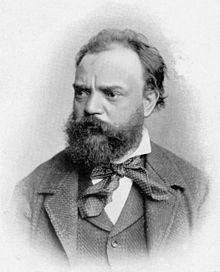
Antonin Dvorak, composer (1841 – 1904)

Scherzo capriccioso, Opus 66 has the name of a light-hearted, even playful music, but this is not. Written in 1883, Dvorak’s mother had died recently and three of his children had passed away during earlier years. There is a darkness behind the sunny music. This piece was written before his time in America, 1892 – 1895. He was devoted to Bohemia’s music and wanted to let his home be heard by Czech and German audiences. He asked his publisher to put the title page in both languages. Dvorak told him, “I just wanted to tell you that an artist too has a fatherland in which he must also have a firm faith and which he must love.” The composer wisely allowed both audiences to feel the music was their own. The piece is only 12 minutes long, but Dvorak knew what he wanted to keep. The opening has a mood that could be anxious; it has starts and stops. The music is always fascinating: which way will it go? There is a waltz that may be sweet but ironic. The slow middle plays seriously before the English horn and clarinet perform a beautiful passage. The two instruments alternate playing the lovely melody. The final part of the  brings in special parts for horns and the harp. The entire orchestra, called by a solo horn, perform what might be a happy, all notes running as though at a picnic. However, the on and off rhythms and repetitions still let us guess what is in Dvorak’s heart. It is a marvelous piece played with knowing understanding.

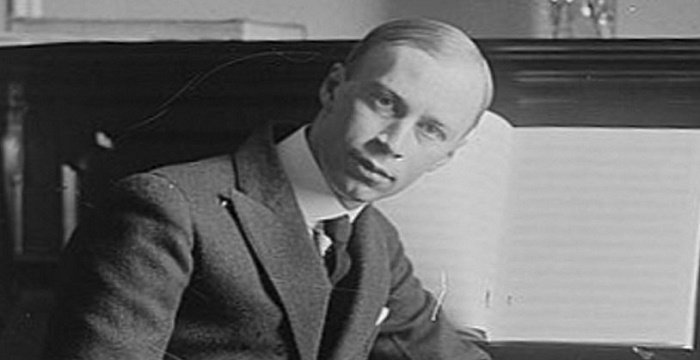
Sergei Prokofiev, composer (1891 – 1953)

Prokofiev’s Piano Concerto No. 3 in C major, Opus 26, helped launch Prokofiev’s works in America. The composer did not fall in love with the USA. His first visit was in 1918. The Spanish ‘flu was killing many. He had come for a 4 month tour but stayed for nearly 2 years. 1918: the Russian Revolution, World War I, and the ‘flu. A dangerous time. Prokofiev’s work seemed too edgy to the Americans. The modernist music put off potential audiences. Serge Koussevitzky, a Russian conductor, became the conductor of the Boston Symphony, starting in 1924. He was a supporter for Prokofiev’s work. In 1918, Frederick Stock, conductor of the Chicago Symphony,  heard Prokofiev’s music and liked it so much that Chicago hosted Prokofiev 5 times beginning in 1921 with the premiere of the Piano Concerto No. 3. The music of this Concerto is an exciting roller coaster. The energy comes from a mix of neoclassical, modernist, and traditional styles. There are often so many things happening that there is no point in keeping one’s ears in enjoying the castanets or the piano flying through unusual syncopation variations. The music seems to take on sounds that are played simultaneously but from different directions. The orchestra and piano challenge the differences and hear all of them as one majestic piece. It is the bassoons that bring on the piano and create a back and forth race to the end. It would need hearing again in order to analyze the music: What is doing what to which phrase or instrument? Yet the music is so exciting it is more than worth hearing it again. Prokofiev was the foremost pianist in the St. Petersburg Conservatory. It is appropriate to have Alexandre Kantorow step into Prokofiev’s pianist life. Kantorow played Liszt’s transcription of Wagner’s Liebestod from Tristan und Isolde as his encore.

Pianist Alexandre Kantorow and Conductor Karina Canellakis with the SF Symphony

Jean Sibelius wrote the Four Legends from the Kalevala, Opus 22 (1896) when he was becoming interested in the Finnish epic, the Kalevala. In his childhood, he spoke Swedish. Finland was controlled by Sweden and then became a grand duchy ruled by Russia. He did not learn Finnish language until his mother put him in a Finnish speaking school. He was around 11 years old. He began to adopt Finnish music, folktales, and Finnish culture when he moved to Vienna. His friend and future wife, Aino Jarnefelt, wrote to him in Finnish; he would respond in Swedish. In a letter he stated that he would reply in Swedish “so that it does not take five minutes to write out each word.” This was the era in which authors, composers, scientists, historians were seeking their communities’ identities through folk tales and music. The hero of these tales is  Lemminkainen. The 4 legends are: Leminkainen and the Maidens of the Island, the hero lands on an island with many young women all of whom he seduces. Then the island’s men return and the hero must leave; The Swan of Tuonela, the Swan swims in the waters of Tuonela, the place of the dead; Lemminkainen in Tuonela, the hero is taken into the water and killed. His mother comes to Tuonela to bring him home and give him life; Lemminkainen’s Return, the hero’s mother brings him home, puts the pieces together with special honey, and he is whole. He goes to Pohjola for revenge, but the mistress of Pohjola puts frost over the water, his boat, and all his crew. The hero keeps the Frost away, though he and his companion have to go home by walking on the ice. Some of the instants remind one of Ulysses’ adventures and other creatures which might do him in. The music is beautiful. Sibelius began the parts of the Legends in 1893, but started over. He made a new work of the Swan of Tuonela. He revised it in 1939; the 4 pieces were published in 1954. Each legend has its own environment in sound. The Swan of Tuonela has a sad English horn over the strings. There are 17 parts. The third and fourth ending display the battles, struggles, and homeward travel. Without the story, it is still deeply moving and beautiful. Sibelius reaches into the rhythms of the epic poetry and the sounds of language turned into gorgeous music.

Please note: Photos are by Brittany Hosea-Small by courtesy of SF Symphony. Quotation from Sibelius is taken from the SF Symphony program notes found by Alicia Mastromonaco.


Photos by Brittany Hosea-Small, by courtesy of SF Symphony

ITZHAK PERLMAN: SUBLIME & MORE THAN PERFECT

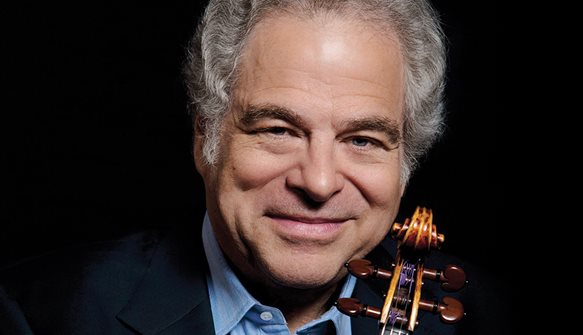
Itzhak Perlman is “the reigning virtuoso of the violin.”  His playing is perfect, and his joy of life is playful, too. He comes to Davies Symphony Hall, San Francisco, usually once a season; but his appearance is not always a recital. On November 4, 2025, it was just him, the violin, his pianist, Rohan de Silva, and the piano. It was a performance in which every note was the best of every note. His playing reminds his audience to treasure each moment.

Itzhak Perlman

He offered three pieces: Wolfgang Amadeus Mozart’s Violin Sonata in G major, K.301 (1778), Cesar Franck’s Violin Sonata in A major (1886), and Antonin Dvorak’s Violin Sonatina in G major, Opus 100 (1893).  Mozart’s Violin Sonata was a delight. The music has a special place in history. In the past, the violin did not have as much music to play or presence as the piano. Mozart changed this. When he was 22 years old, he wrote five violin sonatas in Mannheim, published them in Paris, and found success. In the first movement, Allegro con spirito, each of the instruments play together, collaborate, or even pluck notes from the other instrument’s harmony. They fit together.The second movement, Allegro, is a Rondo with a rondo’s repetitions. The music is delicious; we are happy to have Mozart come close to repeat while making key changes and gracious decor.

It seems that Cesar Franck’s family, especially his father, held him back from his ability in music. He was allowed to study at the Paris Conservatory. He was good in piano and composition, but not considered brilliant. He returned to his home in Belgium and became an organist and teacher. He married against his father’s permission. That brought him out of his shell, but his bride was as controlling as his father. In 1872, he was promoted to the professorship of the organ at the Paris Conservatory. He felt the new status, and it gave him a chance to take hold of his own music. His students included successful composers such as d’Indy and Chausson. Franck reached into new directions in his compositions; his students may have picked up his discoveries. Conservatory colleagues were taken aback by the freedom Franck developed and what might be an assault on tradition. The works he wrote in the last decade of his life are full of imagination and sensuality. In the Violin Sonata in A major, he explored new techniques and musical romanticism. There is a cyclical theme that winds through all four movements. Virtuosic music, deeply Romantic, lyrical; its sounds are original. The Recitativo-fantasia,  the third movement, makes order of a different order. Then, in the fourth movement, Allegretto poco mosso, the listener hears and feels oneself flinging self and emotion into the wild.

Antonin Dvorak, composer, (1841 – 1893)

The story of Dvorak spending time in America is probably well known. Jeannette Meyers Thurber wanted to start a conservatory. She wanted to include women, disabled, and minority students. The National Conservatory of Music of America began in 1885. Ms Meyers Thurber wanted to receive national funding. It did not come through. She wisely sought an internationally known musician; Dvorak became the director in 1892 and left in 1895. Dvorak told his publisher that the Sonatina in G major, Opus 100 was written in part so that young people “(dedicated to my two children)” and “adults, should be able to converse with it.”  As Scott Foglesong wrote, it “was stripped of Wagnerian complexities,” though it kept Classical traditions of sonatas and rondo. He included in this Sonatina, and other compositions, America’s native music including African American and Native American. The Sonatina includes folk themes and rhythms. Itzhak Perlman’s incredibly fast playing stood out and became faster and faster, but without losing the model of folk dancing. It would have to be light footed folk doing the jumps and turns. Fast jumps and turns. Perlman, the master of Franck’s attraction by lyrical music reaching out for a slow embrace, Itzhak Perlman is also the virtuoso of Dvorak’s intercultural American music.

The performers presented the wonderful ritual of Perlman & De Silva encores. After many bows, the three persons required for the encores return. The violinist, the pianist, and the page turning woman who returned to the stage carrying a stack of music books. The straight forward fiddling around deciding which piece Itzhak Perlman would play is hysterical. They think maybe this one but no, they might do this other one. Here is the list of encores on Nov. 4, 2025.

  1. Fritz Kreisler – Liebesfreud
  2. Christoph Gluck – “Melodie” from “Orfeo ed Euridice”
  3. Fritz Kreisler – Tambourin Chinois
  4. Piotr Ilyich Tchaikovsky – Chant sans paroles
  5. Piotr Ilyich Tchaikovsky – Humoresque
  6. John Williams – Theme from Schindler’s List

 Each one was superb music. We do not get to hear enough of Kreisler. The encores and Perlman humor are unique. And then, he played Schindler’s List to remind us that music and life are real.

If you have the opportunity, like maybe Itzhak Perlman is performing less than 500 miles away, get the ticket. Rohan De Silva, pianist, is the tops. Together, they are perfect partners.

and, CELEBRATE ITZHAK PERLMAN’S 80TH BIRTHDAY!!!